
Raising Refugee Leaders
2020
By Kelly Mehee Shin
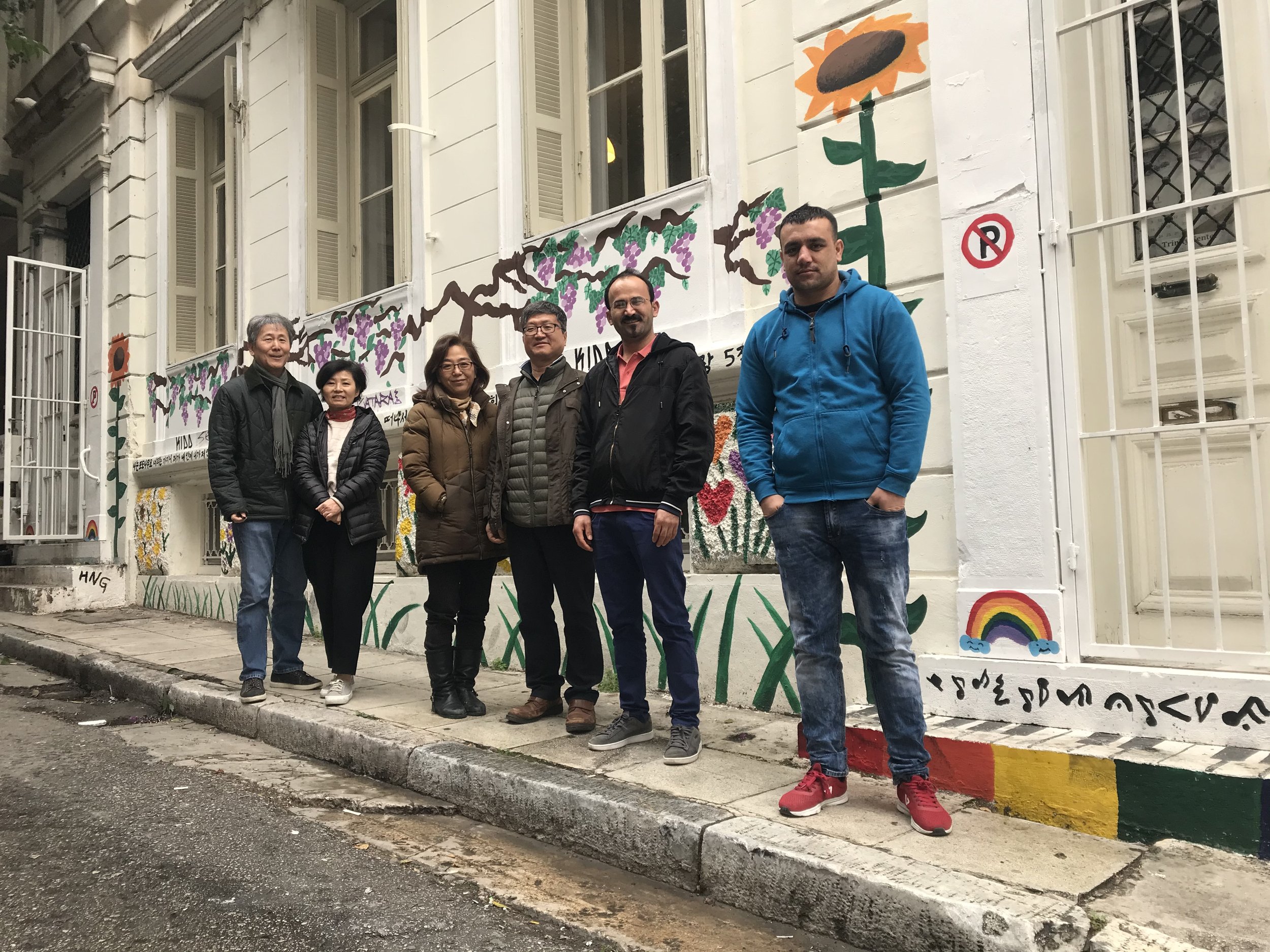
Fred and Kelly Shin with the Korean missionary couple who helped provide the basement ministry space and two of the first four Grace Mission University MDiv students in Athens in January 2020. The other two students were studying online from Türkiye.
A VISION FOR LEADERS FROM WITHIN
As we continued serving among Persian-speaking refugees,
we saw many people who were eager to learn about the Christian faith.
Yet there were very few trained leaders who could teach Scripture,
disciple new believers, and shepherd emerging faith communities
in their own language and culture.
Through a Korean pastor serving in Athens, we were introduced to
English-speaking university graduates from refugee backgrounds
who desired to study theology and serve others. In 2020,
four students began pursuing Master of Divinity degrees
online through Grace Mission University in the United States.
Two studied from Athens, while the other two continued
their courses from Türkiye.
We believed that healthy, lasting ministry required leaders
to be raised from within the refugee community.
These students understood the experience of displacement,
the questions of Persian-speaking believers, and the cultural realities
that outside workers could never fully share.
Supporting their education became an important step toward
equipping future pastors, teachers, and ministry leaders.
MORE THAN A SCHOLARSHIP
For students living as refugees, beginning a graduate theological
program involved challenges far beyond tuition.
Uncertain legal status, limited income, unstable housing,
language barriers, and the responsibilities of daily survival could
easily interrupt their studies.
Our support therefore included more than educational expenses.
We sought to provide access to computers and internet,
a stable place to study, housing assistance when needed,
practical care, and regular mentoring. We wanted the students
to know that they were not walking through the process alone.
Leadership formation also required more than completing
academic assignments. We studied Scripture, prayed,
discussed ministry challenges, and encouraged the students
to serve others while they learned. The goal was not only
to develop theological knowledge, but also to cultivate spiritual
maturity, faithfulness, humility, and a shepherd’s heart.
LEARNING THROUGH SERVICE
The students did not wait until graduation to begin serving.
As opportunities arose, they helped with interpretation, Bible studies,
refugee outreach, educational programs, and practical care for
individuals and families.
Serving while studying allowed theological lessons to be tested
in real situations. Ministry brought questions that could not be
answered by textbooks alone: how to listen to someone carrying
trauma, guide a new believer patiently, respond to conflict,
and remain faithful when progress was slow.
These experiences helped reveal both gifts and areas that still
needed growth. Through study, mentoring, and hands-on service,
the students gradually developed confidence and learned that
Christian leadership is not primarily about position or recognition.
It is about serving people, carrying responsibility, and following
the example of Jesus Christ.
SEEDS FOR THE YEARS AHEAD
At the beginning, we could not know where each student’s journey
would lead. We simply prayed that God would use their education,
experiences, and gifts to strengthen Persian-speaking believers
and serve refugee communities.
Developing leaders is slow work. It requires more than a course,
a degree, or a short period of training. There are setbacks, transitions,
difficult decisions, and seasons when growth is not immediately visible.
Faithful mentoring means continuing to walk together through each
of these seasons.
The investment that began with four students helped establish
a lasting conviction within Koinonia Ministry: healthy churches
and Home Churches require biblically grounded, spiritually mature,
and locally connected leaders. This same vision would later shape
our church ministries, leadership development,
and the establishment of Bible College Europe.
REFLECTION
Every leader’s journey is different. Education may open a door,
but character, calling, faithfulness, and maturity are formed
over time through both opportunities and difficulties.
We learned that raising leaders requires trust and accountability,
encouragement and correction, patience and discernment.
Supporting someone does not mean controlling the outcome.
It means providing opportunities, walking together honestly,
and remaining faithful to the responsibilities God has given us.
We cannot manufacture Christian leaders. Only God can shape
a person’s heart and calling. Our role is to teach, mentor, support,
create opportunities for service, and help each person recognize
both their gifts and responsibilities.
Those first four students changed the way we understood
refugee ministry. We no longer wanted only to do ministry
for refugees. We wanted to develop ministry with them
and help equip leaders who could faithfully serve their own people
and the wider body of Christ.